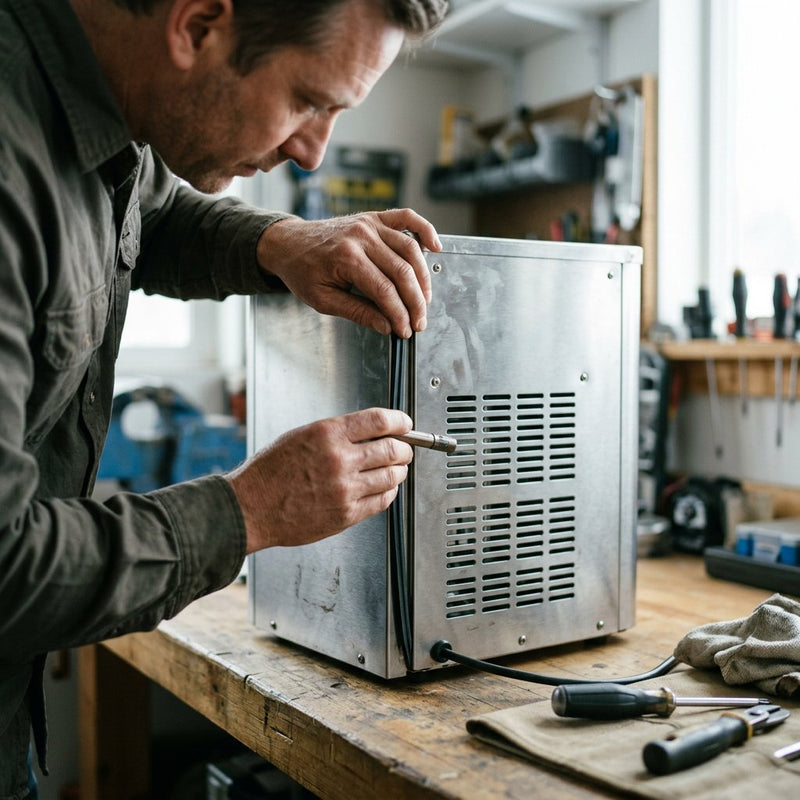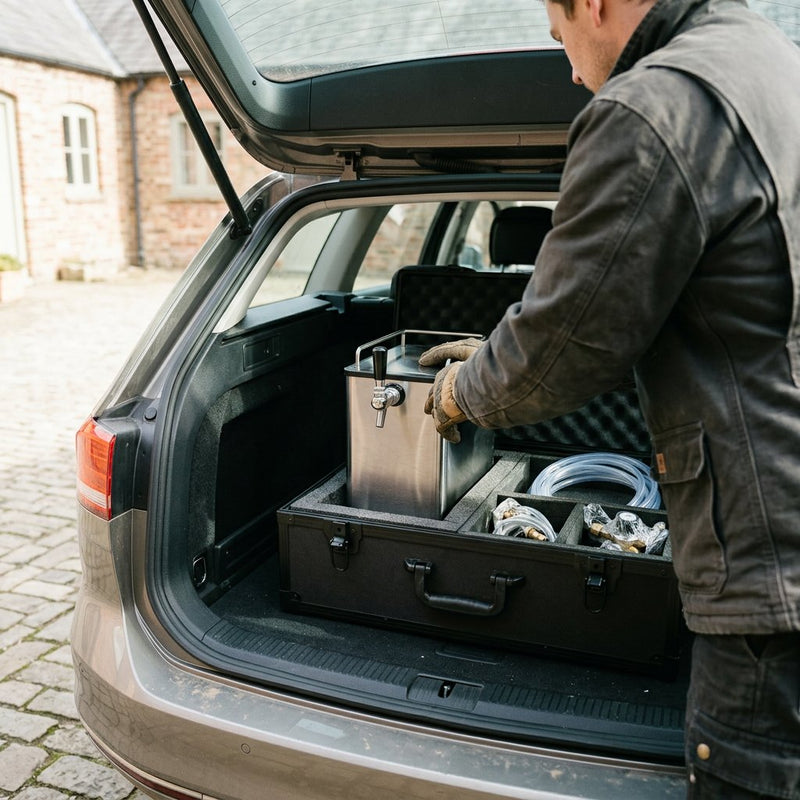
A coupler only works properly if the keg valve, coupler type, gas supply, and lines are all compatible. Even a poorly chosen coupler, swapped connections, or a keg that is too warm can prevent the beer from flowing, cause excessive foaming, or leave the connection leaking.

Connect dispensing head
The safest approach always follows the same steps: prepare the system with low pressure, place the correct coupler cleanly on the keg, lock it properly, connect the beer and gas lines correctly, and only then slowly build up the pressure. Below, you will see what to check before connecting, which coupler types are common, which components are needed, and how to quickly identify typical dispensing errors.
What to check before connecting
The coupler is the connection between the keg valve, gas line, and beer line. It ensures that the keg can be controlled and pressurized with gas and that the beer flows through the system to the tap. For this to work reliably, the coupler must fit the keg's valve system exactly. The beer brand is therefore not the primary consideration, but rather the design of the keg valve. Learn more about how it works and its design: How does a coupler work?
Before connecting, always check that the keg system, coupler, seals, threads, and hose connections are all compatible. Even seemingly similar couplers are not necessarily compatible. A coupler should only be placed on the keg valve if it fits securely and without force. If the locking mechanism does not engage properly or the seal does not sit flat, the system is likely incorrect.
The condition of the entire system is equally important. The keg, coupler, and lines should be clean, undamaged, and prepared for connection. Close the gas supply before connecting, check the seals for cracks or deformation, and ensure the keg is sufficiently cooled. Beer that is too warm, dirty couplers, or damaged connections often lead directly to foaming, leaks, or an unstable beer flow.
You need these parts for a clean connection
For a standard keg connection on a conventional beer dispensing system, you need the following components:
- A keg with a clearly identified valve system so that the correct coupler can be selected.
- A coupler that fits the keg mechanically and is precisely matched to the valve via the seal.
- A CO₂ or dispensing gas source with a pressure regulator so that the working pressure can be controlled and adjusted.
- Beer and gas hoses with suitable fittings, threads, and diameters; the gas inlet and beer outlet on the coupler must not be confused.
- Suitable cooling or a sufficiently cooled keg to keep the beer flow stable and reduce foaming.
- A tap or a complete dispensing system to deliver the beer from the keg to the glass.
- Special solutions such as party pumps, systems without CO₂, or certain KeyKeg systems may be configured differently; this article focuses on the standard connection using a coupler.
How to connect the coupler step by step
When connecting a coupler, following a set sequence helps prevent incorrect connections, leaks, and unnecessary foaming:
- Close the gas supply and prepare the system with low pressure. Only release the residual pressure in a controlled manner before working on the keg or coupler.
- Check that the selected coupler really fits the keg valve and that the seal, connections, and locking mechanism are clean and undamaged.
- Place the coupler straight onto the keg valve. Do not tilt it or force it into place.
- Lock the coupler completely according to its design until it clicks into place and sits securely.
- Connect the beer and gas lines correctly using suitable hoses and fittings. Do not swap the gas inlet and beer outlet, and ensure the fittings are correct.
- Only then open the gas slowly and carefully build up the pressure. Then check the seal and beer flow at low pressure and make fine adjustments if necessary.
You can find detailed step-by-step instructions here: How to connect a keg properly.
Important: Never disconnect a coupler under uncontrolled pressure. Always close the gas supply first and release the pressure in a controlled manner before disconnecting.
Which coupler fits which keg?
The most important basic rule is: there is no universal coupler. The keg valve, sealing surface, and locking mechanism are always the deciding factors. Therefore, you should not choose a coupler based on the beer brand, but rather on the keg system actually being used. The coupler directory helps identify commonly requested systems such as Type A/Flat, Type D/Basket, Type M/Combo, KeyKeg, and special Guinness/Kilkenny solutions.
There is therefore no generally applicable answer to the question of which coupler is the "most common." In practice, certain systems are more common than others, but only the coupler designed specifically for the respective keg valve is suitable.
| Keg system | How to identify it | What you need | Signs it probably won't fit |
|---|---|---|---|
| Type A / Flat | If the keg, product description, or existing coupler is explicitly identified as Type A or Flat, you should follow this system specification exactly. Do not rely solely on a visual assessment, as similar designs are easily confused in everyday use. The keg system's marking is the deciding factor. | You need a suitable Type A Flat coupler with a compatible seal, as well as matching beer and gas connections. The threads, fittings, and hose sizes must also match the rest of the system. Only when the coupler, seal, and connection technology work together will the connection be leak-proof and operate properly. | Warning signs include an angled fit, lack of a secure form-fit, resistance when locking, or a seal that does not sit flat. If the coupler only fits with pressure or by "giving it a little extra help," it is not a good fit but a clear indication of an incompatible system. |
| Type D / Basket | If the keg or dealer's specification is listed as Type D or Basket, you need exactly this system. Basket and other standard couplers are frequently confused because couplers from other systems can look similar. The beer brand is not the deciding factor here, but rather the clear keg or supplier specification. | You need a coupler expressly designed for Type D or Basket. This also requires the correct seal, a properly connected gas line, and a beer outlet that matches the existing line. A mechanically similar coupler from another system cannot reliably replace this fit. | If the locking mechanism does not close completely, the coupler has play, gas leaks from the side, or there is no clean beer flow after pressure has been built up, you should immediately check the system again. Often, the problem is not the keg, but rather an incorrect coupler or a seal that is not sitting properly. |
| Type M / Combo | For kegs marked Type M or Combo, you need a matching Combo coupler. The name "Combo" can easily lead to the assumption that the coupler is particularly universal. It is not. This system also requires an exactly matching coupler with the correct locking mechanism and sealing surface. | Use an M/Combo coupler with suitable gas and beer connections, as well as appropriate fittings for your hoses and the rest of the system. Before attaching it, check that the seal is clean, flexible, and undamaged. Even a worn seal can make an otherwise suitable system unreliable. | A clear warning sign is if the mechanism partially closes but does not click into place properly, or if the coupler does not sit securely after locking. Leaks at the coupler, an unstable beer flow, or pressure loss immediately after connecting also indicate that the system, seal, or connection are not correctly matched. |
| KeyKeg | KeyKeg is a separate container system and should always be identified by the specific system specification. It is particularly important not to simply assume it is a standard metal keg. Check the marking on the container, the supplier's documentation, or the product description of the accessories being used. | You need the coupler designed for this system, or the correct coupler, and a matching connection solution. Depending on the specific design, the setup may differ from a standard keg connection. Therefore, you should always check before connecting whether the coupler, gas line, and other system components are expressly designed for the respective system. | If a standard coupler cannot be attached properly, the gas side remains unclear, or there is no clear system approval, you should not improvise. Uncertainty about the correct system is a stronger warning sign here than with standard keg systems, because seemingly similar solutions can quickly lead to incorrect connections. |
| Guinness/Kilkenny special solutions | For Guinness or Kilkenny kegs, the brand name alone is not enough to help you choose. The specific keg and system design are the deciding factors. Depending on the system, these containers may require special couplers and, if necessary, special gas supply requirements. Therefore, always check the exact system specification on the keg or with the supplier. | Only the special solution expressly designed for the respective keg system should be used. In addition to the coupler, the required gas type or gas supply may also differ from standard CO₂ operation. The specifications of the respective system are always the deciding factor, not a general assumption based on other beer kegs. | If the coupler is only described generally, no clear suitability for the specific system is stated, or the gas supply does not clearly match the keg, you should not force the connection. Special solutions are frequently affected by problems not with the keg, but by an inaccurate system identification. |
| Unclear or missing system specification | If there is no clear marking on the keg or if the information is contradictory, you should not choose the coupler by guesswork. Check the marking on the container, the supplier's documentation, or the label on a coupler that has already been used and is known to fit properly. Visual similarity does not replace this check. | Before purchasing or connecting, it is sensible to clarify the system question definitively. Trautmeyer can provide assistance upon request in selecting suitable couplers, connections, and sensibly combined components. This prevents incorrect purchases and reduces the risk of dispensing from a perfectly functional keg using the wrong coupler. | Typical warning signs of an incorrect fit include forcing the locking mechanism, a wobbly fit, seals that do not sit flat, threads that only fit with transitional solutions, or immediate leaks on the gas or beer side. If the connection itself does not appear clearly correct, you should check the identification again. |
Remember this practical rule: a coupler must fit without improvisation. As soon as the connection can only be made with force or the locking mechanism does not clearly close, you should not continue working, but rather check the system, seal, and connections again.
Correctly set CO₂, pressure, and temperature
CO₂ has two functions in a dispensing system: it draws the beer from the keg and simultaneously helps keep the carbonation stable in the beer. Therefore, the set pressure has an immediate effect on foaming, taste, and flow behavior. If the pressure is too low, the beer often flows erratically or does not start flowing properly at all. If it is too high, the beer can lose excessive carbonation and foam excessively.
There is no universal pressure setting. The specifications for your beer and system are always the deciding factor. Key considerations include the beer type, keg and product temperature, the length and diameter of the beer line, the design of the tap, and the available cooling. A keg that is not sufficiently cooled often cannot be dispensed smoothly even with a properly fitted coupler.
For standard systems, a CO₂ supply with a suitable pressure regulator is often the right solution. How to set the working pressure correctly: How to set a CO₂ pressure regulator. In special cases or with keg solutions that depend on the system, other gases or special requirements may be relevant; in such cases, you should follow the specifications of the respective system.
These connection errors occur particularly often
Many dispensing problems arise during the initial setup or due to missing coupler accessories. These errors are particularly common:
- The coupler was chosen based on the beer brand or habit rather than the keg's actual valve type.
- The keg is too warm or the cooling is insufficient; this causes even a correctly connected system to foam quickly.
- The working pressure was adopted as a general setting without considering the beer, temperature, line, and system design.
- The gas and beer connections were confused or not clearly matched to the correct connection on the coupler.
- Hose, thread, or fitting sizes do not match properly; this leads to leaks, pressure loss, or poor flow.
- The coupler, lines, or seals are dirty or worn; this causes not only hygiene problems, but often dispensing issues as well.
If no beer flows or too much foam is produced
The following check points help to quickly identify typical connection problems:
| Symptom | Check first | Common cause |
|---|---|---|
| No flow | Coupler fits, is properly locked, gas is present, pressure has been built up, beer line is clear | Incorrect coupler, no gas pressure, or coupler not fully opened |
| Too much foam | Check keg temperature, pressure setting, seal integrity, cooling, and stable beer flow | Keg too warm, pressure too high or unbalanced, leaking connection |
| Too little foam or flat beer | Pressure is not too low, CO₂ supply is present, system is correctly matched | Pressure too low or unsuitable supply for the respective system |
| Slow beer flow | Lines are clear, coupler correctly chosen, locking mechanism fully engaged, pressure is correct | Pressure too low, partial blockage in the beer line, or incorrect coupler |
| Leak on the gas or beer side | Check seals, fittings, threads, hose sizes, and coupler fit | Incompatible connections, damaged seal, or coupler placed at an angle |
Leave the keg connected, disconnect properly, and keep it clean
A keg can temporarily remain connected if the system is leak-proof, the keg is sufficiently cooled, the pressure is correctly set, and the system is operated hygienically. However, this is not a general recommendation for every situation. During longer breaks, before transport, when cleaning is required, or if the connection does not appear to sit securely, it is better to disconnect the keg.
To disconnect safely, first close the gas supply and release the pressure in a controlled manner. Only then release the coupler's locking mechanism and remove the coupler from the keg. Afterwards, couplers, connections, and seals should be cleaned and checked for wear. Dirty couplers or aged seals are a frequent cause of a perfectly suitable system becoming leaky or malfunctioning the next time it is connected.