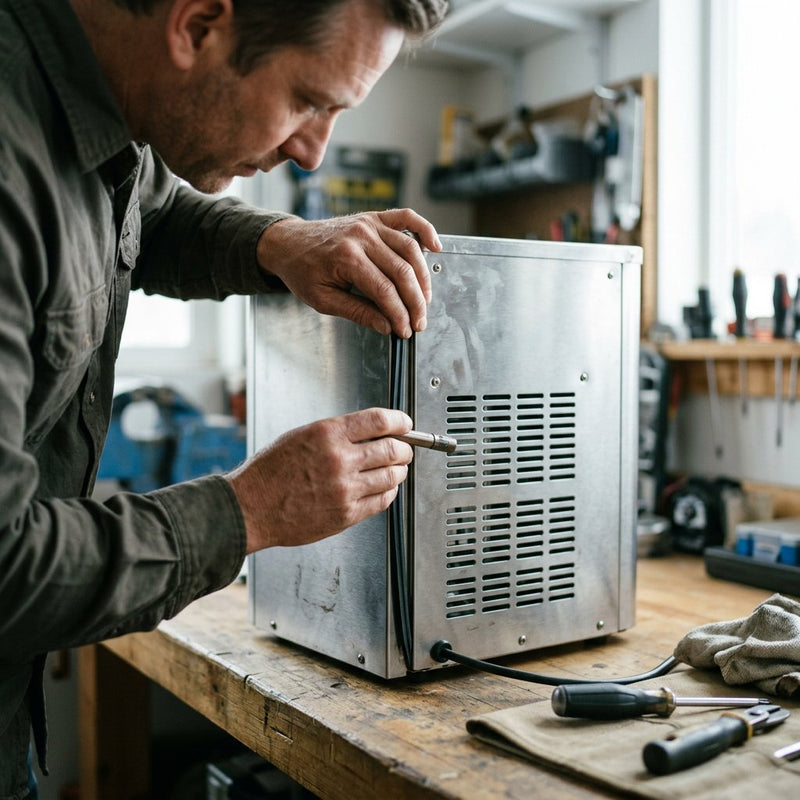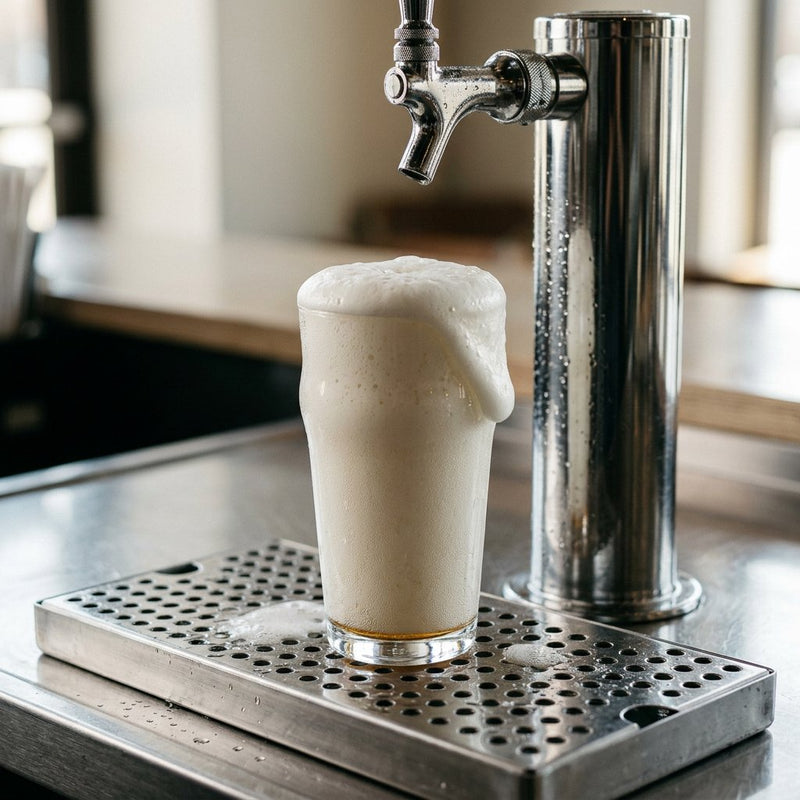
Whether for home use or in the catering industry, not every dispensing system is equally easy to move. Compact countertop devices and dry coolers are usually more mobile than heavy wet or under-counter solutions. For safe transport, it is especially important to depressurize the system, secure loose parts separately, and plan for the subsequent reconnection and cleaning from the outset.

Transporting a draft beer system
Which designs are easy to move – and which are not
| Design | For mobile use | Typical advantage | What increases the effort |
|---|---|---|---|
| Dry cooler | Usually well suited | Compact, often quicker to set up and take down | More lines, higher cooling capacity, additional accessories |
| Wet cooler | Rather limited | Stable cooling in a fixed location | Higher weight, liquid in the system, more caution during transport |
| Countertop device | Often easy to transport | The device often remains manageable as a compact unit | Protruding attachments must still be secured |
| Under-counter solution | Usually for fixed locations | Clean integration on site | Installation, line routes, and additional components make moving it difficult |
| Compact complete system | Often more practical | Fewer loose parts due to integrated components | With every expansion, the space and handling requirements increase |
Before transport: depressurize the system and secure loose parts
- First, pull the mains plug, disconnect the keg and gas supply, and depressurize the system before loosening the connections.
- Remove the beer and gas hoses, dispensing head, adapters, drip tray, and other accessories, label the parts, and pack them neatly.
- Depending on the design, check whether residual beer, condensate, or water may leak out, and secure or drain the system accordingly.
- Sensitive or protruding components should preferably be padded separately rather than remaining mounted on the device.
Carry, load, and secure it in the vehicle safely
- If you are transporting a dispensing system, check the weight, dimensions, and available handles early on; for heavy devices, a second person, a trolley, or a ramp is often useful.
- Move the device upright as much as possible and secure it in the vehicle against slipping, tipping, and hard impacts.
- CO₂ cylinders should be transported separately from the device, securely upright, and not loosely between other accessories, in accordance with the manufacturer's instructions and applicable safety regulations (see Storing a CO₂ cylinder correctly (safety)).
- Kegs and heavy additional parts can often be loaded separately more safely than leaving them unnecessarily on the device; helpful information can be found on Storing beer kegs: the right temperature.
What to pay attention to with CO₂, hoses, and connections
How much effort a transport will take often depends not only on the dispensing system itself, but on the entire pressure and line system. A solution with an external CO₂ cylinder, pressure regulator, and multiple lines inevitably brings more individual parts than a compact device. This makes clear organization and suitable components even more important, especially if you have to set the CO₂ pressure regulator after transport. Pre-assembled hoses, quick connectors, and the right dispensing head or adapter make setup and teardown significantly clearer. As soon as multiple lines or different keg systems are in use, all parts should be labeled and always packed the same way. For regular changes of location, a dedicated mobile set of hoses, adapters, plugs, and pressure accessories is useful. Anyone who needs help with the selection will usually benefit from a needs-based compilation rather than randomly combined individual parts. When reconnecting after transport, the Keg connection: Instructions is helpful.
Reconnect quickly and cleanly at the location
At the destination, the location should be checked first: securely placed, easily accessible, and with practical line routes. The guide Connecting a dispensing system – step by step helps with the proper procedure: first the beer line and dispensing head, then the gas supply and pressure accessories, and finally the power and cooling. Compact dry coolers are often quicker to get back into operation than larger or more permanent systems. Other designs may require more lead time after transport or be subject to manufacturer instructions. Before starting the first pour, briefly check for leaks, pressure, temperature, and flow. This saves time and reduces the risk of leaks or unnecessary foam.
Clean and store correctly after use
- Clean beer-contact parts and lines as soon as possible after use; especially during periods of inactivity, you should clean the beer line.
- After cleaning, store hoses, dispensing heads, adapters, drip trays, and pressure accessories dry and, if possible, as a complete set.
- For occasional use, compact modular systems are often more practical because they are easier to store and can be fully assembled again later.
- Anyone who works mobile more frequently should include cleaning agents and suitable cleaning equipment as part of their basic equipment.
When a mobile or ready-to-use solution makes more sense
If a dispensing system for home use or the catering industry is to change locations regularly, Mobile dispensing systems, ready-to-use dispensing systems, and compact countertop devices are often the more practical choice. Large under-counter systems, multi-line systems, and heavy professional devices are usually better suited to fixed locations. For certain uses, dispensing systems without CO₂ can also reduce the effort because fewer external components need to be carried – Party pumps for on the go are practical here. However, the interaction between the main device and the accessories is always crucial. Suitable dispensing heads, hoses, pressure regulators, plugs, and cleaning accessories should be planned from the outset. Especially with frequent changes of location, a needs-based compilation or a suitable complete set is often more practical than a later assembled mix of individual parts.