As a rule of thumb: Compared to wet coolers or ice bank coolers, dry coolers are usually ready for use more quickly; wet coolers (ice bank coolers) often require about 30 to 60 minutes of lead time before the first pour. However, this time affects the device, not necessarily the entire keg. A through-flow cooler only cools the beer as it passes through the cooler to the tap. Whether the first glass is cold right away and has little foam therefore also depends on the room temperature, the keg or beverage temperature, free ventilation, and the correct start-up of the system. More background information is provided in the article Dry cooler or wet cooler? Differences at a glance.

Pre-cooling a circulating chiller: How long?
The cooling technology determines the waiting time
| Design | Typical lead time | What it is practically suitable for | Important influencing factors |
|---|---|---|---|
| Dry cooler | Usually short, often only a few minutes until ready for use | If dispensing needs to start quickly | Warm environments, blocked exhaust air, and high dispensing volume extend the time until stable coldness is achieved |
| Wet cooler or ice bank cooler | Frequently about 30 to 60 minutes, depending on the device, it may be more or less | Often makes sense for longer dispensing periods and higher continuous performance | The cooling reserve must first build up; free ventilation and sufficient lead time are particularly important |
| DryWet systems | Depending on the design, between the two types | If fast availability and stable cooling are both important | The manufacturer's specifications, installation, and actual ambient temperature are decisive |
How a through-flow cooler cools the beer when dispensing
A through-flow cooler has a clear function: It does not cool down the entire keg, but the beer on its way through the cooling section to the tap. In the device, heat is removed from the beverage. The system must then release this heat back to the environment. That is exactly why free air circulation is always part of the cooling performance.
If the cooler is too close to the wall, under a warm counter, or without clean exhaust air, the temperature in the device rises more quickly. Then the device is running, but the actual cooling at the tap falls short of expectations. In practice, temperatures in the lower to mid single-digit range are often aimed for dispensing, always suitable for the beverage, line, and device setting. The warmer the keg and environment are, the more work the cooler has to do until this range is stably reached. The function of the through-flow cooler is therefore precise dispensing cooling when tapping, not complete keg cooling.
How to properly commission the through-flow cooler
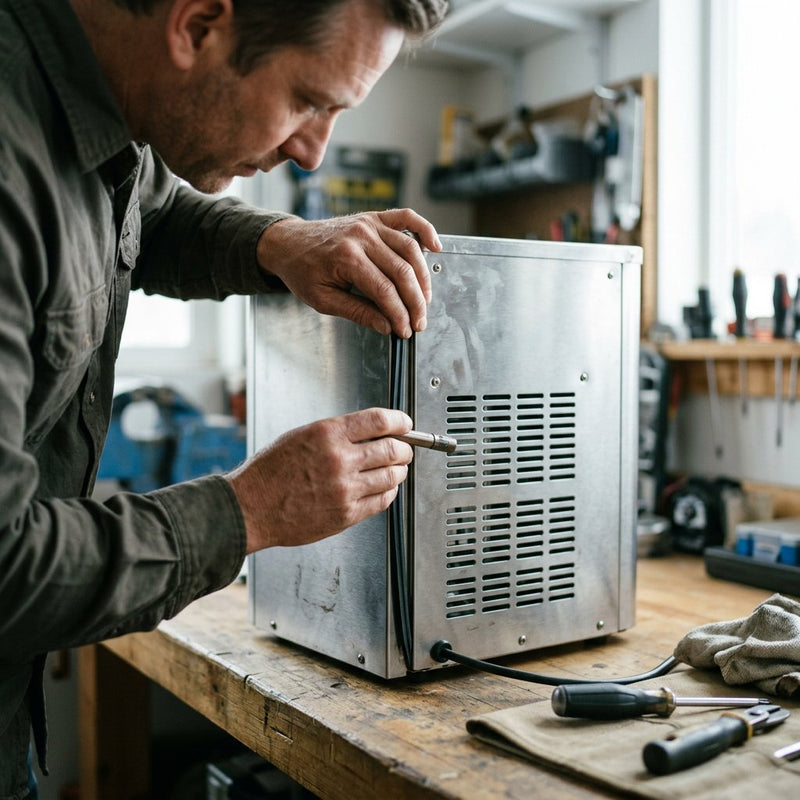
With a clean and correctly installed device, you avoid many problems even before the first glass. You can find detailed instructions here: Connecting a through-flow cooler: Step-by-step.
- Place the through-flow cooler securely and leave the inlet and exhaust air free. The device should not have to work against a heat buildup in a niche or directly against a hot wall.
- Check the power supply, location, and ambient temperature before switching on. Especially in warm rooms, the practical time tends to shift towards the upper end of the usual lead time.
- Connect the beverage lines and, if applicable, the pressure side cleanly and correctly. After cleaning, no problematic residues may remain in the lines that interfere with the start or affect the dispensing.
- Let the device start up in a controlled manner and refer to the manufacturer's specifications. Instead of immediately focusing only on the maximum cold setting, a clean start with observation of the cooling effect is usually more sensible.
- Deliberately plan the necessary lead time before the first pour. With dry coolers, it is usually shorter; with wet or ice bank coolers, building up the cooling reserve usually takes more time.
If short pre-cooling times are important, dry cooler sets facilitate the quick start.
Does the keg also need to be pre-cooled?
Not necessarily always, but often makes sense in practice. A through-flow cooler can also cool the beer at the tap even if the keg itself has not been pre-cooled. Nevertheless, a warm keg puts significantly more strain on the system. The greater the gap between the keg temperature and the desired dispensing temperature, the more likely foam tendency and temperature fluctuations are, especially with smaller or mobile devices.
Therefore, attention should be paid to the temperature when storing beer kegs, even if the cooler takes over the actual dispensing cooling. Very warm storage, for example in summer heat, makes smooth dispensing significantly more difficult and brings the through-flow cooler to its performance limit more quickly.
If the beer foams: first check the causes, then work on the pressure
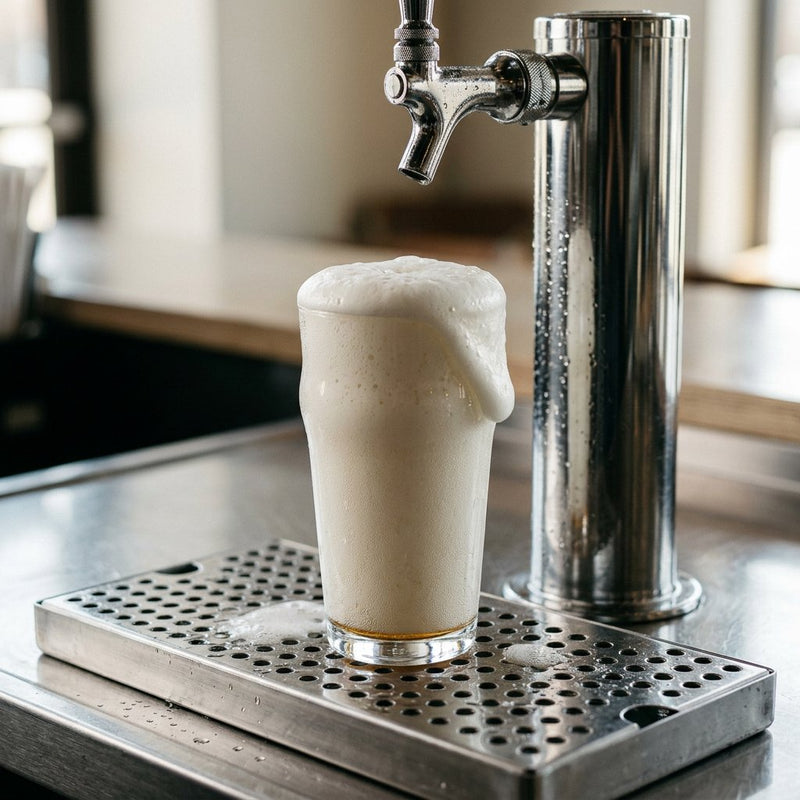
If the beer foams, a pressure change is not automatically the right first measure. First check the typical causes in combination.
- Check the temperature: If the keg is too warm or the cooler has not yet had enough lead time, the beer arrives unstable at the tap and foams significantly faster.
- Check cooling performance and ventilation: A blocked through-flow cooler or a device with too little power for the current dispensing cannot dissipate the resulting heat quickly enough.
- Do not lower the pressure blindly: Counterpressure and CO2 pressure must suit the beverage, line, height, and dispensing behavior. A spontaneous pressure reduction can hide the actual problem, but not solve it cleanly.
- Use the tap correctly: A compensating tap helps to control the flow better. However, it does not replace a harmonious temperature and pressure setting of the entire system.
- Keep lines clean: Dirty lines, bottlenecks, or residues from cleaning and operation disrupt the uniform flow and promote foam formation.
- Dispense more slowly with very warm beer: A through-flow cooler can only dissipate a limited amount of heat per unit of time. If very warm beer needs to be cooled down significantly, slower dispensing is often necessary.
How long does a 5-liter keg stay cold?
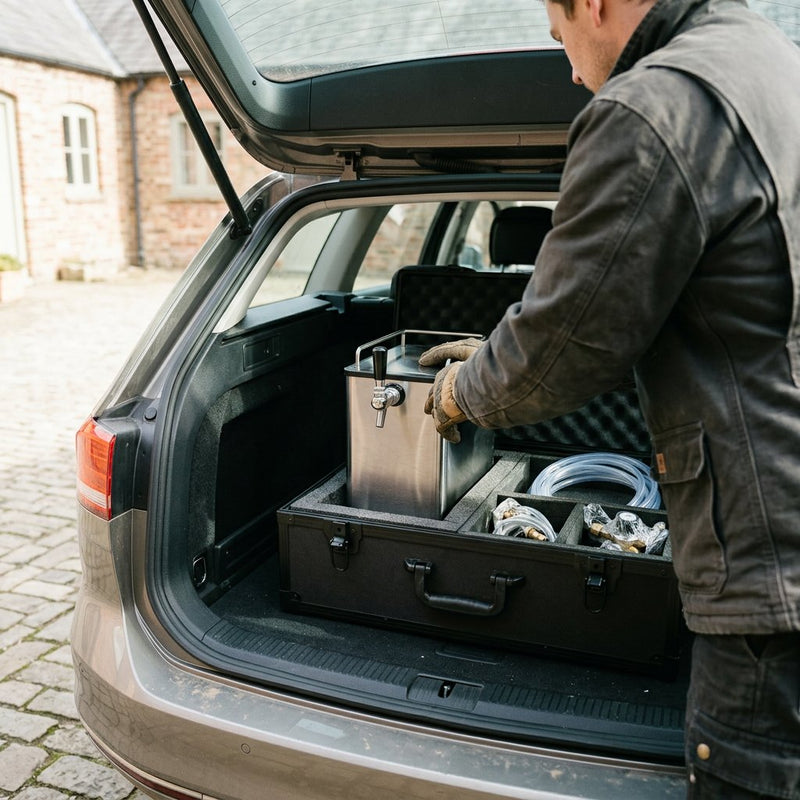
A through-flow cooler does not automatically keep a 5-liter keg completely cold for a long time. It can cool the beer during dispensing, but the keg mass itself continues to absorb heat from the environment. How long a mini-keg stays cold therefore depends above all on the starting temperature, the room temperature, the dispensing volume, and additional cooling or insulation.
If the 5-liter keg is warm at the beginning, cooler beer will initially arrive at the tap, but with several glasses in a row, the load quickly increases. For repeated dispensing, a suitable dispensing system with a through-flow cooler is usually the more stable solution than an uncooled 5-liter keg. You can find suitable devices here: Buy through-flow coolers.