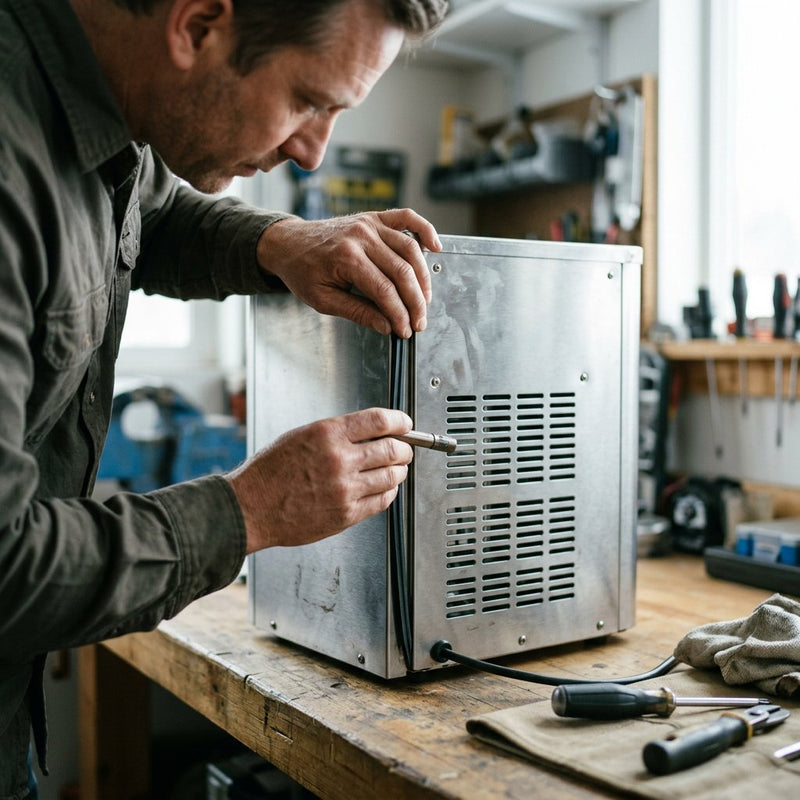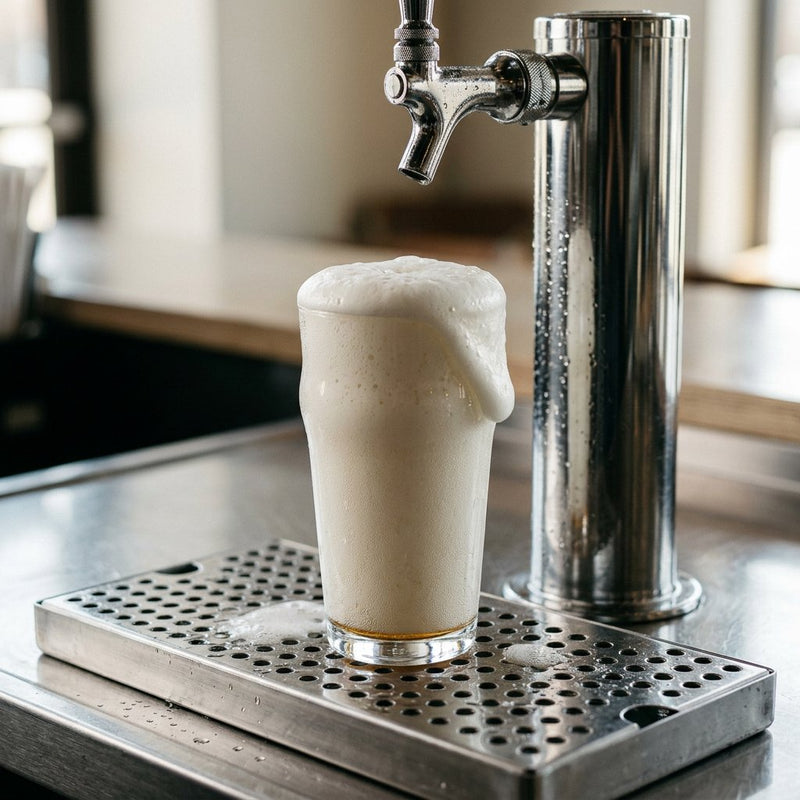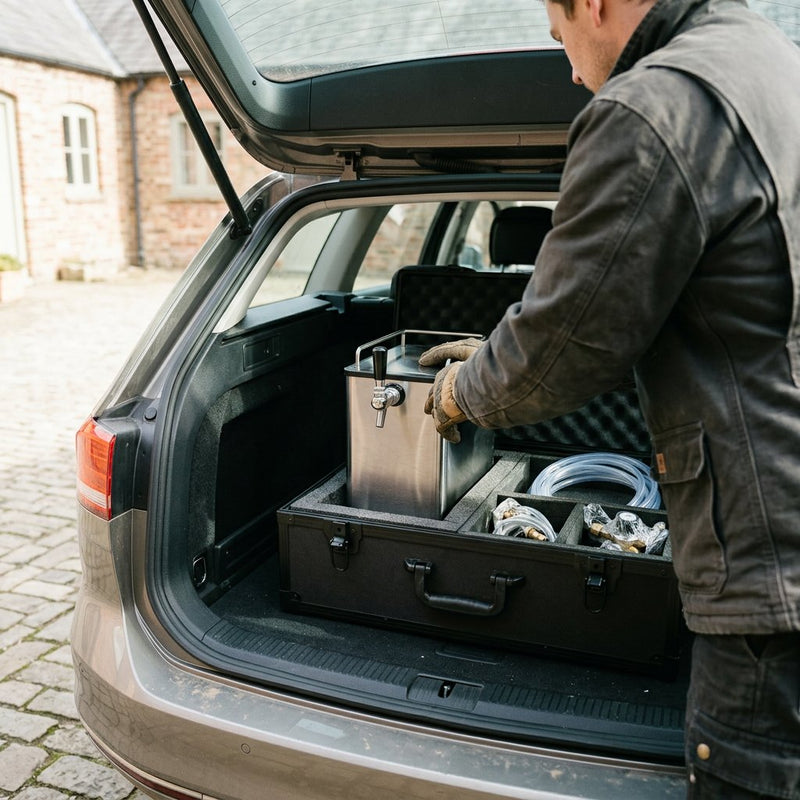
When changing the CO2 cylinder on your dispensing system, the correct sequence is crucial: first close the cylinder valve, then depressurize the gas side, and only then loosen the pressure regulator. The full cylinder is reconnected upright, then you slowly open the valve, reset the working pressure, and check all connections for leaks. This helps prevent leaks, pressure problems, and unnecessary dispensing disruptions.

Changing the CO2 cylinder on the dispensing system
Changing the cylinder is not just a formality. Without a stable CO2 supply, dispensing performance usually suffers immediately: the flow becomes erratic, the foaming behavior changes, and the carbon dioxide retained in the keg is no longer properly balanced. These instructions apply to dispensing systems with an external CO2 cylinder or a cylinder connection. Whether to exchange an empty cylinder or have it refilled depends on several factors, including the quality of the gas used, the condition of the cylinder, and the current inspection deadline.
Why a CO2 supply is crucial for clean dispensing
At a dispensing system, CO2 does more than just build up pressure. The gas pushes the beverage out of the keg through the line and tap, while simultaneously stabilizing the carbon dioxide in the keg. This is precisely why an interrupted or faulty gas supply affects not only the flow rate but also the final result in the glass. If there is insufficient pressure, the beverage often flows unevenly or not at all. If the pressure does not match the system, the dispensing performance can deteriorate significantly.
The working pressure must be correctly set and as constant as possible. It is regulated by the pressure regulator and must suit your system, the beverage, and the intended application. A value that is too low can cause carbon dioxide to escape more easily from the beverage and make dispensing unstable. A value that is too high can also disrupt dispensing performance. Therefore, after every cylinder change, you must not only connect the new CO2 cylinder but also carefully restart the regulator and reset the working pressure according to your system manufacturer's instructions.
For many users, it is also important to distinguish what type of system they are using. These instructions are intended for dispensing systems that operate with an external CO2 cylinder or a fixed cylinder connection. For smaller cartridge, capsule, or manufacturer-specific gas systems, the basic principle is similar: stop the gas supply, depressurize the system, safely change the connection, and check for leaks. However, the specific handling can differ significantly, particularly regarding the connection type, seal, or system depressurization. The respective manufacturer's instructions always remain the primary authority. If lines or connections need to be reconnected after changing the cylinder, the Dispensing System Connection – Instructions guide is helpful.
Especially with home dispensing systems and classic CO2-powered dispensing systems, the extent to which even minor leaks affect performance is often underestimated. A minimal leak at a fitting, a pinched seal, or a regulator that is not properly seated can be enough to prevent the working pressure from remaining stable after the change. In such cases, it may initially seem as though the new cylinder is the problem, although the cause is often the connection between the cylinder, pressure regulator, and gas line. Anyone who understands the CO2 supply as a continuous chain will usually identify errors more quickly and achieve much cleaner dispensing in the end.
Safely changing the CO2 cylinder on the dispensing system: step by step
Completely close the cylinder valve. First stop the gas supply directly at the connected CO2 cylinder. Never work on a connection while the cylinder is still open.
Depressurize the gas side. Reduce the working pressure at the pressure regulator and depressurize the gas side using the designated depressurization method or according to your system manufacturer's instructions. Do not continue working until the pressure has been completely released.
Disconnect the CO2 pressure regulator from the empty cylinder. Ensure the cylinder is securely positioned and work only while it is upright. Use suitable tools if required by your connection and loosen the connection in a controlled manner.
Check the connection and seal. Before reconnecting, inspect the thread, sealing surface, and seal intended for your connection. Damaged or hardened parts should not be reused.
Connect the full CO2 cylinder upright. Seat the pressure regulator properly, align the connection without tension, and tighten it appropriately. Temporary solutions or crookedly fitted fittings are a common cause of leaks.
Slowly open the valve and put the regulator into operation. Open the cylinder valve in a controlled manner, not abruptly. Then reset the working pressure intended for your system – you can find step-by-step guidance here: Correctly setting the CO2 pressure regulator.
Check all connections for leaks. After the change, inspect the connections to the cylinder, pressure regulator, and hose, as well as any pressure regulator accessories, before dispensing again. The system should only be used normally once the gas lines are leak-tight and the pressure is stable.
Before reconnecting, check the following points
Does the cylinder fit the connection? The cylinder, pressure regulator, and connection thread must match. It is not only the cylinder itself that matters, but the complete combination of valve, regulator, fitting, and suitable gas cylinder accessories.
Is the pressure regulator suitable for beverage dispensing systems? Use only a regulator designed for this purpose on a dispensing system. The appropriate working pressure depends on the system, beverage, and manufacturer's instructions.
Is food-grade CO2 being used? Only CO2 suitable for this application may be used for beer and other beverages. The gas type and application must match.
Are the seal, hose, and fittings in good condition? Even minor leaks quickly lead to pressure loss. Therefore, check seals for proper seating and condition, and inspect hoses and connections for visible damage.
Is the cylinder securely and uprightly positioned? CO2 cylinders should generally be operated upright and protected from heat. During the change, the cylinder should also be secured against tipping.
Avoid these errors and safety risks
Never loosen under pressure. CO2 cylinders are under high pressure. If connections are loosened when the gas supply is not closed or the gas side has not been depressurized, the risk of uncontrolled gas release and damaged connections increases significantly.
Do not use cylinders that are unstable or operated horizontally. A wobbly or incorrectly positioned cylinder is a typical safety risk when changing cylinders. The cylinder should be securely positioned, operated upright, and secured against falling over.
Do not continue to use damaged parts. Worn seals, damaged threads, kinked hoses, or fittings that require excessive force to fit should not be used. Especially on the gas side, temporary solutions are a common cause of leaks.
Do not blindly assume the operating pressure. Simply opening the valve and continuing to dispense after the change without deliberately checking the pressure regulator often leads to incorrect dispensing. The working pressure should always be rechecked to suit the system and beverage.
Do not ignore leaks. If you notice hissing, a drop in pressure, or a change in the dispensing performance after connecting, do not continue to operate the system without checking it. Only after the connection, seal, regulator, and gas line have been inspected is the gas side reliably ready for operation again.
Do not use unsuitable cylinders or unclear refilling solutions. For dispensing systems, it is not enough for a cylinder to fit externally. Its condition, inspection deadline, valve design, and the suitability of the CO2 used for beverages must also be correct.
Exchange the empty cylinder or have it refilled?
Whether exchanging or refilling is more sensible usually depends less on a general principle than on availability, waiting time, and the condition of your cylinder. For many users, the deciding factor is how quickly the system can be ready for use again and whether the supplier will accept the existing cylinder for refilling. If you need a replacement cylinder immediately, you can find suitable CO2 cylinders for dispensing systems here.
| Point | Exchange the cylinder | Have the cylinder refilled |
|---|---|---|
| Speed in everyday use | Often practical if downtime should be kept short and a suitable replacement cylinder is immediately available. | Sensible if you want to continue using your own cylinder and the waiting time for refilling suits you. |
| Possible options | Depending on the offer from specialist dealers, other dealers with a suitable range, or possibly through a designated shipping process. | Depending on the offer from local specialist dealers, specialized refilling stations, or other providers that accept CO2 for this purpose. |
| Condition of the cylinder | It remains important that the replacement cylinder fits the connection of your dispensing system and is suitable for use. | Acceptance may depend on the condition of the cylinder, for example, a valid inspection deadline, an intact valve, and the required protective equipment. |
| Predictability | Often good if you want to dispense again quickly and are not tied to a single cylinder. | Good if the refilling route is reliably accessible to you and you deliberately want to continue working with your existing cylinder. |
| What you should always pay attention to | Even with a replacement cylinder, the CO2 must be suitable for beverages and the cylinder must technically match the system. | Not every refilling solution is suitable for dispensing systems. Food-grade CO2 is mandatory for beer and other beverages. |
Our experience with CO2 components on dispensing systems
As a specialist provider of dispensing and beverage technology, we repeatedly see the same pattern when changing cylinders: the crucial interfaces are rarely just at the cylinder itself, but at the transition between the cylinder connection, seal, pressure regulator, and gas line. This is precisely where typical problems arise after a change, such as insufficient working pressure, gradual pressure loss, or a dispensing performance that suddenly no longer looks right.
This is why, with home dispensing systems as well as classic CO2-powered setups, we first look at the regulator, hose routing, and fittings. If pressure is missing after the change, an incorrectly seated seal is often just as relevant as an unsuitable or improperly set pressure regulator. Because dispensing technology is constructed differently depending on the system, we clearly distinguish professionally between systems with an external CO2 cylinder and other system types for which these change instructions are not intended. In practical terms, this means that not only the full cylinder and the CO2 supply matter, but the complete chain of connection, seal, regulator, and gas line.